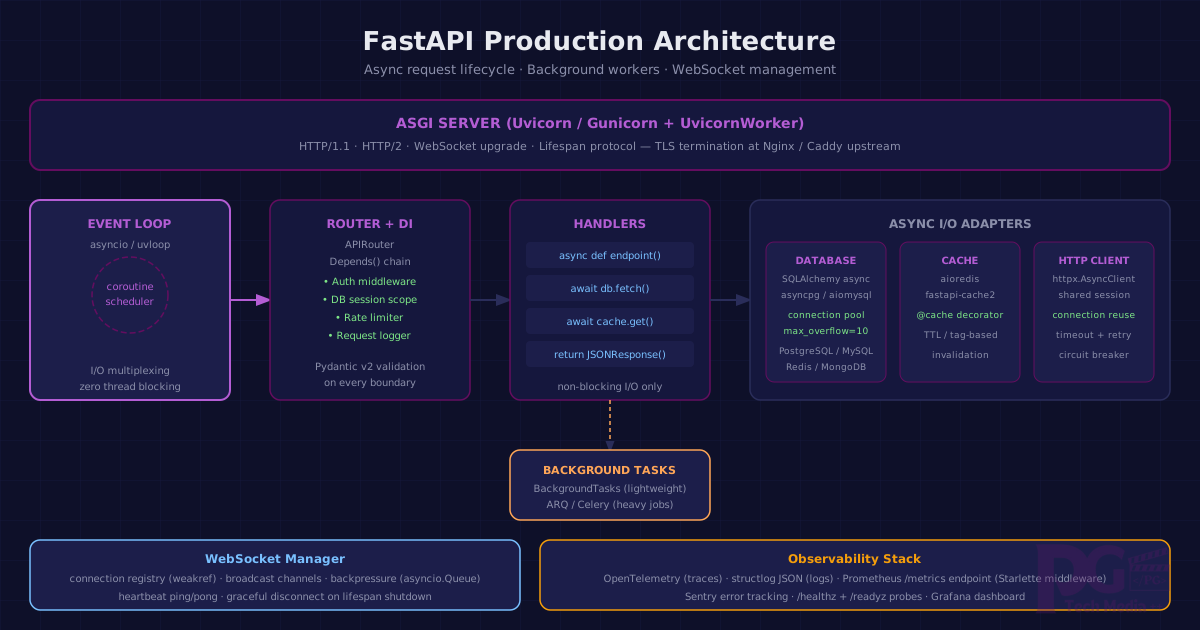
FastAPI in Production: The Architecture Patterns Engineers Actually Use

PraiseGod
11 min read
FastAPI in Production: The Architecture Patterns Engineers Actually Use
FastAPI is an excellent framework. Its combination of type-driven validation, OpenAPI generation, and async-first design makes it genuinely productive for building APIs. What the documentation covers less thoroughly is the operational runtime: connection lifecycle management, background job orchestration, graceful shutdown, structured logging, and the async pitfalls that degrade performance in subtle ways.
This post covers the patterns that production deployments actually use.
Application Lifespan: The Foundation
FastAPI 0.93+ ships lifespan as the canonical way to manage startup and shutdown state. Use it for everything that needs to be initialized once per process and cleanly torn down.
1from contextlib import asynccontextmanager
2from fastapi import FastAPI
3import httpx
4from sqlalchemy.ext.asyncio import create_async_engine, AsyncSession
5from sqlalchemy.orm import sessionmaker
6
7@asynccontextmanager
8async def lifespan(app: FastAPI):
9    # Startup
10    engine = create_async_engine(settings.DATABASE_URL, pool_size=10, max_overflow=20)
11    app.state.db_factory = sessionmaker(engine, class_=AsyncSession, expire_on_commit=False)
12    app.state.http_client = httpx.AsyncClient(timeout=httpx.Timeout(10.0), limits=httpx.Limits(max_connections=100))
13
14    yield  # Application runs
15
16    # Shutdown — order matters
17    await app.state.http_client.aclose()
18    await engine.dispose()
19
20app = FastAPI(lifespan=lifespan)
The critical point: never create a new database connection or HTTP client per request. A httpx.AsyncClient initialized per-request skips connection reuse entirely, negating HTTP Keep-Alive and destroying performance under load. The lifespan-managed shared client reuses the connection pool across all requests in the process lifetime.
Dependency Injection That Scales
FastAPI's Depends() system is powerful but can become a performance concern if not used carefully. Dependency resolution runs on every request. Keep dependencies lightweight.
Database session pattern:
1from typing import AsyncGenerator
2from fastapi import Depends, Request
3from sqlalchemy.ext.asyncio import AsyncSession
4
5async def get_db(request: Request) -> AsyncGenerator[AsyncSession, None]:
6    async with request.app.state.db_factory() as session:
7        try:
8            yield session
9            await session.commit()
10        except Exception:
11            await session.rollback()
12            raise
13
14DbSession = Annotated[AsyncSession, Depends(get_db)]
Authentication with caching: Auth middleware that calls a token validation endpoint on every request will dominate your latency profile under load. Cache validated tokens in Redis with the token hash as key and user identity as value. Set TTL to be shorter than the token expiry. A 100ms auth call becomes a 1ms cache lookup.
1async def get_current_user(
2    token: str = Depends(oauth2_scheme),
3    cache: Redis = Depends(get_cache),
4    db: DbSession = Depends(get_db),
5) -> User:
6    cached = await cache.get(f"auth:{hash_token(token)}")
7    if cached:
8        return User.model_validate_json(cached)
9
10    user = await verify_and_load_user(token, db)
11    await cache.setex(f"auth:{hash_token(token)}", 300, user.model_dump_json())
12    return user
The Async Trap: Blocking in Async Context
The most common FastAPI performance bug is calling a synchronous, I/O-blocking function from an async handler without wrapping it in run_in_executor. A single blocking call in an async handler stalls the entire event loop for every concurrent request.
Danger pattern:
1@app.get("/reports/{id}")
2async def get_report(id: str):
3    # THIS BLOCKS THE EVENT LOOP
4    data = requests.get(f"https://external-api.com/data/{id}").json()
5    return process(data)
Correct pattern:
1import asyncio
2
3@app.get("/reports/{id}")
4async def get_report(id: str, client: httpx.AsyncClient = Depends(get_http_client)):
5    # Non-blocking — yields control to event loop during I/O
6    response = await client.get(f"https://external-api.com/data/{id}")
7    return process(response.json())
If you must use a synchronous library (e.g., a legacy SDK), offload it:
1@app.post("/process")
2async def process_sync_task(data: InputModel):
3    loop = asyncio.get_event_loop()
4    result = await loop.run_in_executor(None, sync_heavy_function, data.payload)
5    return {"result": result}
Background Tasks: Matching the Tool to the Job
FastAPI's built-in BackgroundTasks runs the task in the same process after the response is sent. It is appropriate for lightweight, fast tasks: sending a single email, logging to an external service, updating a cache key.
It is not appropriate for: CPU-intensive work, tasks that take more than a few seconds, tasks requiring their own database transaction lifecycle, or tasks that need retry semantics.
For production background work, use ARQ (async Redis Queue) or Celery:
1# ARQ — lightweight, async-native, Redis-backed
2import arq
3
4async def send_welcome_email(ctx, user_id: str):
5    user = await fetch_user(ctx["db"], user_id)
6    await email_client.send(user.email, template="welcome")
7
8# In your handler — publish to queue, return immediately
9@app.post("/users")
10async def create_user(data: UserCreate, arq_pool: arq.ArqRedis = Depends(get_arq)):
11    user = await user_service.create(data)
12    await arq_pool.enqueue_job("send_welcome_email", user.id)
13    return user
ARQ workers run in a separate process, have their own connection pool, and support retry with exponential backoff. The FastAPI process never blocks on job execution.
WebSocket Connection Management
Ad-hoc WebSocket handling breaks down above a few hundred concurrent connections. The production pattern uses a connection manager with typed channels and backpressure.
1import asyncio
2from collections import defaultdict
3import weakref
4from fastapi import WebSocket
5
6class ConnectionManager:
7    def __init__(self):
8        # weakref avoids holding connections open after client disconnect
9        self._channels: dict[str, set[weakref.ref]] = defaultdict(set)
10
11    def subscribe(self, channel: str, ws: WebSocket):
12        self._channels[channel].add(weakref.ref(ws))
13
14    def unsubscribe(self, channel: str, ws: WebSocket):
15        self._channels[channel].discard(weakref.ref(ws))
16
17    async def broadcast(self, channel: str, message: dict):
18        dead = set()
19        tasks = []
20        for ref in self._channels.get(channel, set()):
21            ws = ref()
22            if ws is None:
23                dead.add(ref)
24                continue
25            tasks.append(asyncio.create_task(ws.send_json(message)))
26
27        self._channels[channel] -= dead
28        if tasks:
29            await asyncio.gather(*tasks, return_exceptions=True)
30
31manager = ConnectionManager()
For horizontal scaling (multiple API instances), replace in-process broadcasting with Redis Pub/Sub. Each instance subscribes to relevant channels and forwards to its local WebSocket connections.
Observability: Structured Logging and Tracing
Production APIs without structured logging are archaeological sites — you can tell something happened but not why.
Structured logging with structlog:
1import structlog
2import time
3
4log = structlog.get_logger()
5
6@app.middleware("http")
7async def request_logging_middleware(request: Request, call_next):
8    start = time.perf_counter()
9    request_id = request.headers.get("X-Request-ID", str(uuid4()))
10
11    with structlog.contextvars.bound_contextvars(
12        request_id=request_id,
13        method=request.method,
14        path=request.url.path,
15    ):
16        response = await call_next(request)
17        duration_ms = (time.perf_counter() - start) * 1000
18
19        log.info(
20            "request_completed",
21            status_code=response.status_code,
22            duration_ms=round(duration_ms, 2),
23        )
24        response.headers["X-Request-ID"] = request_id
25        return response
OpenTelemetry tracing with the opentelemetry-instrumentation-fastapi package instruments your entire application automatically and exports spans to Jaeger, Tempo, or Honeycomb.
Deployment: Gunicorn + Uvicorn Workers
Single-process Uvicorn does not utilize multiple CPU cores. In production, run UvicornWorker under Gunicorn to get multi-process parallelism with async I/O within each worker:
1gunicorn app.main:app \
2  --workers 4 \
3  --worker-class uvicorn.workers.UvicornWorker \
4  --bind 0.0.0.0:8000 \
5  --timeout 30 \
6  --graceful-timeout 30 \
7  --keepalive 5
Worker count: start with (2 × CPU_cores) + 1. Profile under load and adjust. I/O-bound workloads can tolerate more workers; CPU-bound workloads (ML inference, heavy serialization) should match worker count to core count exactly.
Graceful shutdown is not optional. Configure --graceful-timeout to allow in-flight requests to complete before a worker is killed. In Kubernetes, coordinate with terminationGracePeriodSeconds and implement a SIGTERM handler that stops accepting new connections while draining active ones.
The gap between a FastAPI development server and a production-grade service is not in the framework — it is in every operational decision surrounding it.
Share this article
Please or to leave a comment.