Why Your RAG Pipeline Fails in Production (And How to Fix It)

PraiseGod
12 min read
Why Your RAG Pipeline Fails in Production (And How to Fix It)
Retrieval-Augmented Generation is not a difficult concept. The implementation, however, is. A demo that impresses a product team can crumble spectacularly when it encounters real documents, real users, and real query diversity. This post dissects the failure modes systematically and provides the production-grade patterns to address them.
The Deceptive Simplicity of RAG
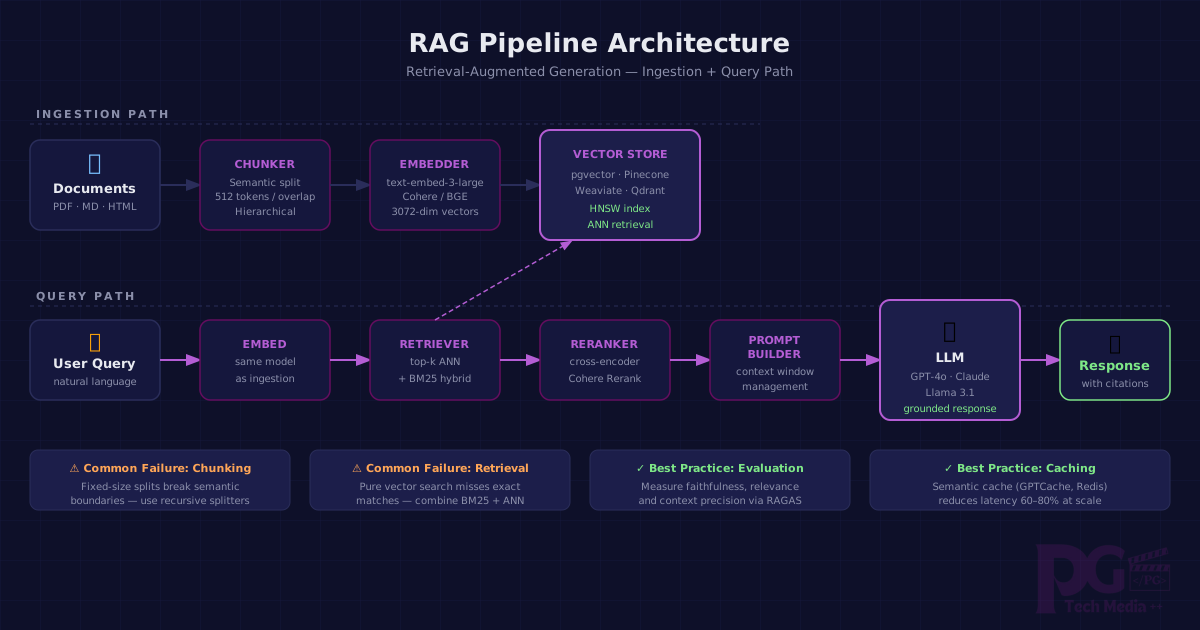
The basic loop is seductive: embed documents, store vectors, embed query, retrieve top-k, stuff into prompt, call LLM. A working prototype takes an afternoon. What takes months to get right is everything beneath that loop.
Every component in the pipeline has failure modes that compound. A 10% degradation at the chunking stage, a 15% miss rate at retrieval, and a prompt construction issue combine into a system that users describe as "randomly wrong" — which is the worst possible failure mode because it erodes trust faster than a system that fails loudly.
Failure Mode 1: Chunking Strategy
Fixed-size chunking is the most common mistake. Splitting documents every 512 tokens without regard for semantic boundaries means a paragraph that explains a concept gets split mid-sentence. The resulting chunks are semantically incomplete and retrieve incorrectly even when the vector representation is technically close.
What works in production:
Recursive character text splitting — LangChain's RecursiveCharacterTextSplitter tries increasingly granular separators (\n\n, \n, ., ) before hard-cutting. This preserves natural paragraph and sentence boundaries for the vast majority of documents.
Semantic chunking — embed sentences and split at embedding-space discontinuities. When cosine similarity between adjacent sentence embeddings drops below a threshold (~0.4), you have a natural topic boundary. This produces variable-length chunks that are semantically coherent at the cost of increased preprocessing compute.
Hierarchical chunking — maintain both a large-context parent chunk (1024 tokens) and a small retrieval child chunk (128 tokens). Retrieve by child chunk (high precision), then expand to parent chunk for context (high recall). This is the current state of the art for most enterprise RAG use cases.
Chunk overlap is not optional. A 20% overlap between adjacent chunks ensures that concepts spanning a boundary appear in at least one complete chunk. The compute cost is trivial; the retrieval improvement is measurable.
Failure Mode 2: Embedding Model Selection
Not all embedding models are equal on your domain. text-embedding-ada-002 is competent on general English text and outright bad on code, scientific notation, and domain-specific terminology where it has not seen sufficient training signal.
Benchmarking methodology: MTEB (Massive Text Embedding Benchmark) provides public leaderboard scores across retrieval, clustering, and classification tasks. But these are general benchmarks. You need to evaluate on your actual document corpus using a held-out question set with human-annotated relevant chunks.
Practical recommendations by domain:
- General knowledge corpora →
text-embedding-3-large(OpenAI, 3072 dims),Cohere embed-v3with input type specification - Code-heavy corpora → fine-tuned
voyage-code-2ornomic-embed-code - Legal / regulatory documents → evaluate
legal-bert-based encoders or fine-tune a base model on your terminology - Multilingual →
Cohere embed-multilingual-v3orparaphrase-multilingual-mpnet-base-v2
Dimensionality vs. performance: Higher dimensions are not uniformly better. text-embedding-3-small at 1536 dims outperforms ada-002 at 1536 dims on most benchmarks while being cheaper. Run the numbers on your actual retrieval F1 before committing to a 3072-dim model and its associated storage / query latency costs.
Failure Mode 3: Vector Store at Scale
An HNSW index that performs excellently at 100k vectors degrades in both recall and query latency at 100M vectors if construction parameters (ef_construction, M) were not tuned for the target scale.
Index construction parameters matter:
M(number of bi-directional links per node) — higher values improve recall at query time but increase memory footprint. For production,M=16toM=32is typical.ef_construction— controls the search effort during index build. Higher values produce a higher-quality graph but slow down ingestion.ef_construction=200is a reasonable starting point.ef_search— the query-time search effort. Tune this independently ofef_constructionto balance recall vs latency. Profile with your actual query patterns.
Filtering kills vector search performance. If you filter by metadata (user_id, document_type, date_range) after retrieval, you are doing full scans of your result set. Use pre-filtering at the index level (pgvector's WHERE clauses with composite indexes, or Qdrant's payload indexing) to keep query latency sub-10ms.
Namespace your index. Multi-tenant RAG systems that share a single index with no partitioning strategy will have cross-tenant contamination risks and uneven load distribution. Use separate collections per tenant (Qdrant) or filtered namespaces (Pinecone) depending on your tenant count.
Failure Mode 4: Retrieval Precision
Pure vector similarity search maximizes semantic recall but performs poorly on exact-match queries. A user asking about "ISO 27001 clause 8.1.1" will get semantically similar but lexically incorrect results if you rely solely on dense embeddings.
Hybrid search is not optional for production systems. Combine:
- Dense retrieval (ANN on embeddings) — captures semantic equivalence and paraphrase
- Sparse retrieval (BM25 / TF-IDF) — captures exact term matches, especially for proper nouns, identifiers, and domain jargon
Reciprocal Rank Fusion (RRF) is the standard fusion strategy. It normalizes rank positions from both result lists and is more robust than score-based fusion when the score distributions differ.
Reranking is your precision layer. After retrieving top-k=50 candidates from hybrid search, run a cross-encoder reranker (Cohere Rerank, BGE-reranker-v2, or Flashrank for cost-sensitive deployments) to rerank and select top-k=5. Cross-encoders score query-passage pairs jointly, capturing relevance that bi-encoder embeddings cannot.
The latency cost of reranking (40–80ms) is worth it. The alternative is prompting the LLM with irrelevant context, which costs more in token spend and produces worse answers.
Failure Mode 5: Context Window Mismanagement
Stuffing all retrieved chunks into the context without regard for ordering, deduplication, or token budget is common and expensive.
Lost-in-the-middle problem: LLMs attend less to content in the middle of long contexts. If your most relevant chunk is chunk 3 of 10, it may contribute less to the answer than chunks at the beginning and end. Position your highest-reranked chunk first.
Deduplication: Chunks from hierarchical index parents and children, or from overlapping text in duplicate documents, produce redundant context that wastes your token budget. Use embedding-based deduplication (cosine similarity > 0.95 → deduplicate) before prompt construction.
Dynamic context length: Do not use a fixed token budget. Implement a context compressor (LangChain's ContextualCompressionRetriever with an LLM-based extractor, or simpler sentence-level relevance scoring) to fit high-density, relevant content into your available context window.
Evaluation: The Non-Negotiable
The only way to know if your pipeline is improving is to measure it. RAGAS provides the standard metrics:
- Faithfulness — does the answer contain only claims supported by the context? (hallucination detector)
- Answer relevance — does the answer address the question? (completeness)
- Context precision — are the retrieved chunks actually relevant? (retrieval quality)
- Context recall — is the needed information present in the retrieved context? (coverage)
Build a golden evaluation dataset of 200–500 question-answer pairs representative of your user queries. Run RAGAS on every significant pipeline change. Treat a drop in faithfulness as a P1 regression.
Production Architecture Essentials
Semantic caching — embed incoming queries and check against a cache of previous query embeddings. Cache hits with cosine similarity > 0.97 return the cached answer in under 1ms. At scale, this eliminates 30–60% of LLM calls. GPTCache and Redis with vector support are standard choices.
Async ingestion pipeline — document ingestion (parsing, chunking, embedding) must be asynchronous and decoupled from query serving. Use a message queue (Kafka, RabbitMQ) with a dedicated embedding worker pool. Never block query serving on ingestion.
Index freshness monitoring — track documents_ingested, chunks_stored, and staleness_seconds as operational metrics. Alert when document-to-chunk delay exceeds your SLA.
The gap between a RAG demo and a RAG system engineers trust at 2am is exactly these details. The architecture itself is not complex — the discipline of getting every component right at each layer is.
Share this article
Please or to leave a comment.